Do You Roll Again for Utilities
This section of the Monopoly wikibook will detail the official rules of the game. The object of the game is to drive all of your opponents into bankruptcy.
Preparation
To fix the game, the following actions are taken:
- The lath is laid out on the playing surface.
- The Chance and Community Chest bill of fare decks are shuffled and laid face down on their designated positions on the board.
- I histrion is selected to be the Broker. The Broker volition manage the Banking company's assets – dealing out title deeds, bonus money and buildings to players, collecting taxes and penalty money, and conducting auctions. The Banker may participate in the game if they want to, but they must keep their personal assets split up from the Bank'southward assets at all times.
- Each histrion selects a token and places it on GO.
- Each player is dealt ₩1,500: two ₩500 notes, 4 ₩100 notes, i ₩50 note, one ₩xx note, two ₩ten notes, i ₩5 notation and 5 ₩1 notes. The exact distribution may differ between editions.
- Each player rolls the die. The player with the highest full goes starting time. In the event of a tie, whorl again.
Basic Gameplay
A player's plow consists of that player rolling the dice and moving their token clockwise that many spaces effectually the board. So, the player undertakes an action corresponding to the type of space they landed on. Then, their plough ends and play passes to the adjacent histrion clockwise from them.
If a player rolls doubles (the aforementioned value on both dice), then after they have resolved the action for the space they landed on they are allowed to ringlet the dice again and take an additional turn. If they gyre doubles a second consecutive fourth dimension, they are immune to take a second additional turn. However, if the player rolls doubles a third sequent time they are "caught speeding" – they must move their token directly to the "In Jail" department of the Jail space, and their plough is over.
Types of Spaces
There are two broad types of spaces in Monopoly – backdrop and action spaces.
Properties
There are 28 properties in the game, each of which has a title deed carte du jour associated with information technology, detailing hire, building cost and mortgage value. The properties are divided as follows:
- Streets are the most numerous property – there are 22 streets in the game. Each street belongs to a colour set alongside one or two other streets. Starting from GO and proceeding clockwise, the colour sets are chocolate-brown (purple in earlier editions), low-cal blue, pink, orange, blood-red, yellow, dark-green and dark blue. Each street space has a coloured bar forth the top indicating what colour fix that street belongs to – this bar is also present on the championship deed.
- In that location are four railroads (also known as stations) located at the centre of each side of the board.
- Finally, there are two utilities, the Electric Company and the Water Works. The Electric Visitor is in betwixt St. Charles Identify/Pall Mall and States Avenue/Whitehall, while the H2o Works is in between Ventnor Avenue/Coventry Street and Marvin Gardens/Piccadilly.
Activity Spaces
There are 12 activity spaces, organised as follows:
- Six card spaces, which are divided into three Risk spaces and three Community Chest spaces.
- Ii revenue enhancement spaces, Income and Luxury.
- The four corner spaces, which are GO, Jail, Gratuitous Parking and Become to Jail.
Landing on Spaces
When a player lands on a space, they take an activeness determined past the type of space they landed on:
- If the player lands on an unowned belongings, they may choose to either buy the property or put it up for auction.
- If the thespian chooses to purchase the property, they pay the property's price, which is listed at the bottom of its space, to the Banking concern. Then the Banker gives them the holding's title deed, which the new owner displays face upward in front of them to designate that they own the property.
- If the player chooses non to purchase the holding, the belongings is put upwards for auction by the Banker, where each role player (including the player who deferred buying the property) attempts to out-bid their opponents. Bidding starts at ₩10 and may be increased by increments of every bit little every bit ₩1. Also, bidding does not accept to follow plow social club. Each player must brand a bid that is ₩one higher than the previous bid. Once bidding has reached a high enough amount that no-one wants to bid any farther, the player who made the highest bid wins the property for the agreed price. They pay the agreed price to the Bank and receive the title deed. Likewise, if no-one wants to bid on the belongings, the belongings remains unsold and the championship human action remains with the Bank.
- If the player lands on a property that is owned by another actor, the owner must enquire them for rent.
- If the possessor asks for rent, the lander must pay the owner rent. The amount of money paid will be stated by the championship act:
- For streets, rent is influenced by the street'due south monopoly status, development level and mortgage status.
- For railroads/stations, rent is determined past how many railroads/stations the owner owns – one railroad/station gives a rent of ₩25, two railroads/stations ₩50, iii ₩100 and all iv ₩200.
- For utilities, the full of the dice is multiplied past a number to give the hire amount. If the possessor owns one utility the dice total is multiplied by 4, and if the owner owns both utilities the dice total is multiplied by 10.
- If the owner fails to ask for rent before the adjacent player in plow club rolls the die, the lander does not take to pay.
- If the possessor asks for rent, the lander must pay the owner rent. The amount of money paid will be stated by the championship act:
- If the role player lands on a Adventure or Customs Chest space, they must draw the top carte du jour from the advisable deck. And then they follow the card'due south instructions, which will either involve paying or losing money or moving to a specific space. Once the instructions have been carried out, the card is returned to the bottom of the appropriate deck.
- The exceptions are the Get Out of Jail Free cards, of which there is one in each deck. If the thespian draws a Go out of Jail Free menu, they must keep it face up upward in front of them until they are ready to use or trade it.
- If the thespian lands on a tax space, they must pay the appropriate amount to the Bank.
- In before versions of the game, a actor who landed on Income Tax was given one of two choices – they could pay ₩200 as with after editions, or they could summate 10% of their full net worth in buildings, cash and properties and pay that. Once locked in the choice was terminal – no elbowroom was given to reverse an unwise choice. The 10% option was eliminated in the September 2008 graphic redesign of the game.
- If the role player lands on Free Parking, Jail or a holding that they ain, cypher happens. The histrion volition move from these spaces on their next turn.
- If the player lands on Jail as part of a normal turn, they place their token in the "Only Visiting" section of the space. They are unhindered and may move from Jail on their next turn.
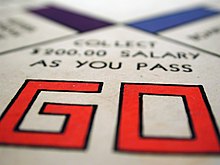
- If the player lands on or passes GO, they receive a ₩200 salary from the Banking concern.
- Finally, if the histrion lands on Go to Jail, they must motion their token to the "In Jail" section of the Jail space immediately! They move directly into Jail, and then they do not pass GO and practice not collect a salary, and their turn is over.
Jail

A piece in Jail. Passing pieces stay off the "In Jail" department in orange.
A thespian will be sent to the "In Jail" department of the Jail space if:
- They land on the Go to Jail space.
- They depict a Take chances or Community Chest card that instructs them to "Become to Jail".
- They roll doubles three consecutive times on the die.
As already stated in the holding actions heading higher up, If the actor lands on Jail as role of a normal turn, they place their token in the "Simply Visiting" department of the space. They are unhindered and may movement from Jail on their next turn.
Whilst a player is in Jail, they will exist unable to move. Withal, they may even so take part in other deportment, such as ownership and selling buildings, taking role in auctions, collecting rent and trading.
In gild to become out of Jail, a player has iii options:
- Pay a ₩50 fine, then roll and move as normal.
- Use a Get Out of Jail Complimentary carte du jour. The card is returned to the lesser of the advisable deck, and so the player rolls and moves as normal.
- The player may gyre the dice. If they gyre a double, they are released from Jail. They will use the roll to move, simply unlike a normal double they will not be allowed to gyre again. If the player does not gyre a double, they remain in Jail.
If the player fails to roll a double by their third turn in Jail, then if the 3rd roll is not a double the player will be forced to pay ₩50. Then they utilize the roll to move.
Buying Buildings
If a player owns all of the streets in a colour set, they accept a monopoly on that color set. Rent on unimproved properties in that colour set volition be doubled, and that player may start ownership buildings on streets in that color set to increase the rent, provided none of the properties in that color fix are mortgaged (which will be explained later on).
Buildings may only be congenital on streets – not on railroads/stations or utilities.
There are two types of buildings in Monopoly: houses and hotels. Houses, which are coloured greenish, are always built first, followed past hotels, which are coloured red. A actor may build buildings at any time they like – they do non accept to await for their turn. The prices of houses and hotels are listed on the street's title deed - ₩fifty for the browns and lite blues, ₩100 for the pinks and oranges, ₩150 for the reds and yellows and ₩200 for the greens and nighttime dejection.
If a player wants to build a house on a street, they pay the corporeality listed on the street's championship act and have a house from the Depository financial institution, which they identify on the colour strip running along the pinnacle of the street'southward lath space.
Players must build evenly – if 1 street in the colour set has a firm, a second house may not be congenital until houses have been built on the other streets. Likewise, a street with two houses may not receive a third until all of the streets in the color set have two houses, and so on.
The maximum number of houses that may exist placed on a street is 4. After that, if all of the streets in that color prepare accept four houses, the player may pay to upgrade the houses to a hotel. The histrion pays the appropriate amount, so returns the iv houses to the Bank and places a hotel on the street'southward color strip. Once a street has a hotel it may non exist improved further.
There are 32 houses and 12 hotels available from the Bank. If there are no houses left in the Bank, no player will be able to purchase new houses until houses are freed upwards, either from being upgraded to hotels or existence sold. If no hotels are left in the Bank, then iv-house groups may not be upgraded until new hotels get available.
The fact that players may purchase buildings at any time may result in a situation where multiple players want to buy the last of a particular edifice. If this happens, the building(s) in question will be put upwards for auction, the sale working the same manner as with a property auction.
Trading
A trade consists of a deal in which two players exchange some of their assets.
A player may propose a merchandise with another player at whatsoever point in the game, fifty-fifty when it is not their turn. There are three assets that may be involved in a trade – money, properties and Go Out of Jail Free cards. The amount traded is decided by the players making the deal.
If a player wishes to trade a street, any buildings on that street'south color fix must be sold beforehand.
The role player who has been offered the trade may take, reject, or advise a counter-offer on their own terms.
Trades may not be used to loan or gift players money.
Assistance! I Can't Pay!
If a thespian finds that they owe coin only practise non have enough physical money to pay the debt, they will need to enhance money to pay the debt. This tin be done by selling buildings and mortgaging properties.
Selling Buildings
If a player wants to sell a building, they render the edifice to the Bank and collect the sale price, which is half of the initial purchase price for buildings in that colour set. Selling a hotel will immediately replace information technology with four houses. And like with ownership buildings, buildings must be sold evenly across the color set.
Mortgaging Properties
A thespian may mortgage a belongings once all of the buildings in its color prepare have been sold. To mortgage, the property'southward title deed is flipped over, revealing the "mortgaged" side, and the player collects the mortgage value from the Banking concern. Whilst a property is mortgaged hire cannot be collected on it. Notwithstanding, mortgaged streets in a monopoly do not forestall the unimproved unmortgaged backdrop in that color gear up from charging double rent. The boosted hire from owning multiple railroads/stations or utilities may be nerveless in the aforementioned manner even if some of those properties are mortgaged.
A player may unmortgage a property after if they take sufficient funds. To unmortgage a belongings, the thespian pays dorsum the mortgage value + 10% interest, and flips the championship deed back over to its "unmortgaged" side.
If a role player receives a mortgaged property through a trade or by bankrupting someone, they must immediately choose between unmortgaging the property or only paying the 10% interest and leaving the holding mortgaged.
Bankruptcy and the End of the Game
If a player is in the very unfortunate situation where they take sold all of their buildings and mortgaged all of their properties, and still do not have enough money to pay a debt, that player is bankrupt, and they are eliminated from the game. What happens side by side depends on who bankrupted them:
- If the player was bankrupted past another player, the creditor volition immediately seize all of the debtor's remaining avails. If mortgaged properties are amid the assets seized, the creditor will immediately accept to decide to unmortgage the backdrop or go on the mortgages.
- If the player was bankrupted by the Bank (e.one thousand. via a tax they do not accept the money to pay), the Bank volition seize all of the histrion'due south avails – Any mortgaged properties have their mortgages cancelled, any coin is returned to the Depository financial institution and any Become Out of Jail Free cards are returned to the bottom of the appropriate decks. So, the Bank volition auction off all of the backdrop that information technology has seized.
The game ends once all simply one role player are broke – that player is the winner.
Other Notes
- The Bank cannot get bankrupt. If the Banking company runs out of coin, the Banker may issue equally much every bit needed past writing on any ordinary paper.
bergeronyoushothe.blogspot.com
Source: https://en.wikibooks.org/wiki/Monopoly/Official_Rules
0 Response to "Do You Roll Again for Utilities"
Post a Comment